Testing Suite
ROLE
Product Designer
TIMELINE
Jan - April 2026
TEAM
Product Manager - Ryan Page
Engineer - Rohith Middela
OVERVIEW
Transforming a "Black Box" into a high-precision testing environment for financial products
Policy Managers are responsible for the logic that powers financial products like loans and credit cards. This isn't just one or two rules; it is a complex web of hundreds of micro-decisions—verifying identity, detecting fraud, and calculating risk.
The Problem: Previously, managers had no way to test these rules themselves. They relied on Engineers to run "Black Box" scripts to verify logic. This was slow, opaque, and created a high risk for manual errors.
The Solution: I designed a Self-Service Simulation Suite that allows managers to test their own rules in a safe sandbox—ensuring they don't make a multi-million dollar mistake before the rules go live.
PCM
THE DISCOVERY
Finding the "Ground Truth"
By shadowing the QA team and analyzing their manual testing workflow, I identified two non-negotiable requirements to bridge the gap between technical stability and business safety:
System Certainty (Intent-Output Alignment)
Managers are legally and financially responsible for their policies. They needed to prove with 100% accuracy that their business intent (the rules they wrote) matched the system's execution (the code's output). This required moving beyond "blind trust" in third-party scripts to a transparent, auditable environment.
Risk Mitigation (Comprehensive Stress-Testing)
In finance, testing the "Happy Path" isn't enough. Managers needed to run hundreds of diverse edge-case personas instantly to ensure a single rule change didn't trigger a "ripple effect" that accidentally auto-rejected thousands of qualified customers elsewhere.
THE CHALLENGE
Beyond the "Black Box"
Strategic Conflict: Speed vs. Accuracy
To hit a tight deadline, the initial plan was to build a "dummy" form that wasn't connected to the bank's live data. I challenged this approach. I argued that proving the software works is not the same as proving the policy works. I advocated for a data-driven architecture that pulls from the live database, ensuring managers test against reality rather than a placeholder.
Managing Information Scale
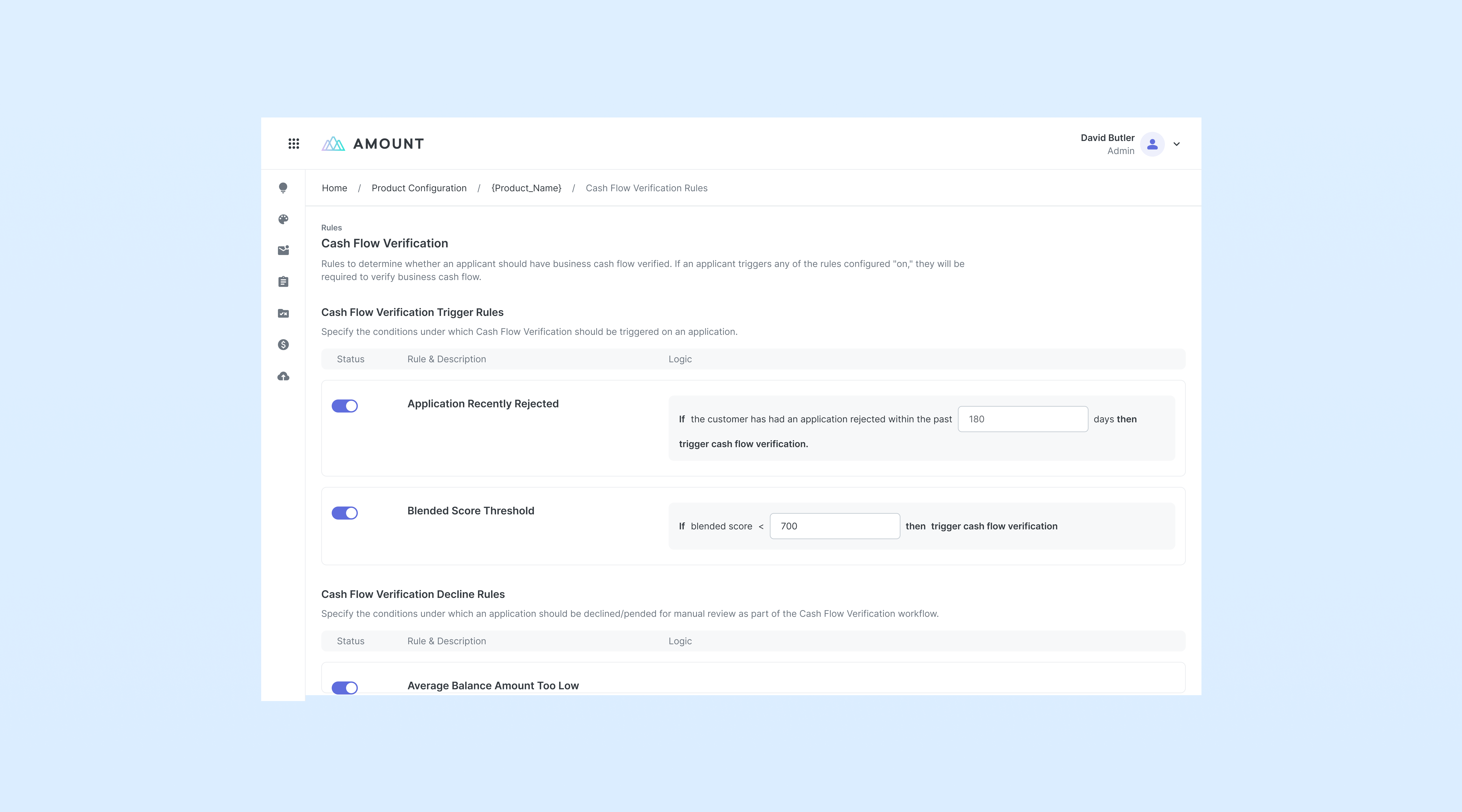
A typical policy uses ~70 rules, but those are pulled from a library of 1,000+ variables. I had to design a workspace that felt lightweight for daily tasks while providing "surgical" access to the full data library. The challenge was hiding the 900+ points of "noise" without sacrificing the power of the tool.
THE ADVOCACY
Negotiating with engineering
I sat down with our lead engineers. I told them: "The generic template is a waste of time. We need to mirror the live database."
The Bottleneck
Manually mapping 1,000+ variables for every product would take months.
The Breakthrough
I proposed using an LLM (AI) Mapper. By using AI to "translate" the messy backend code into our UI, we could build a perfect mirror of any policy in seconds.
SOLUTION
Three Part Design
1. The Mirror Environment (Testing Against the "Ground Truth")
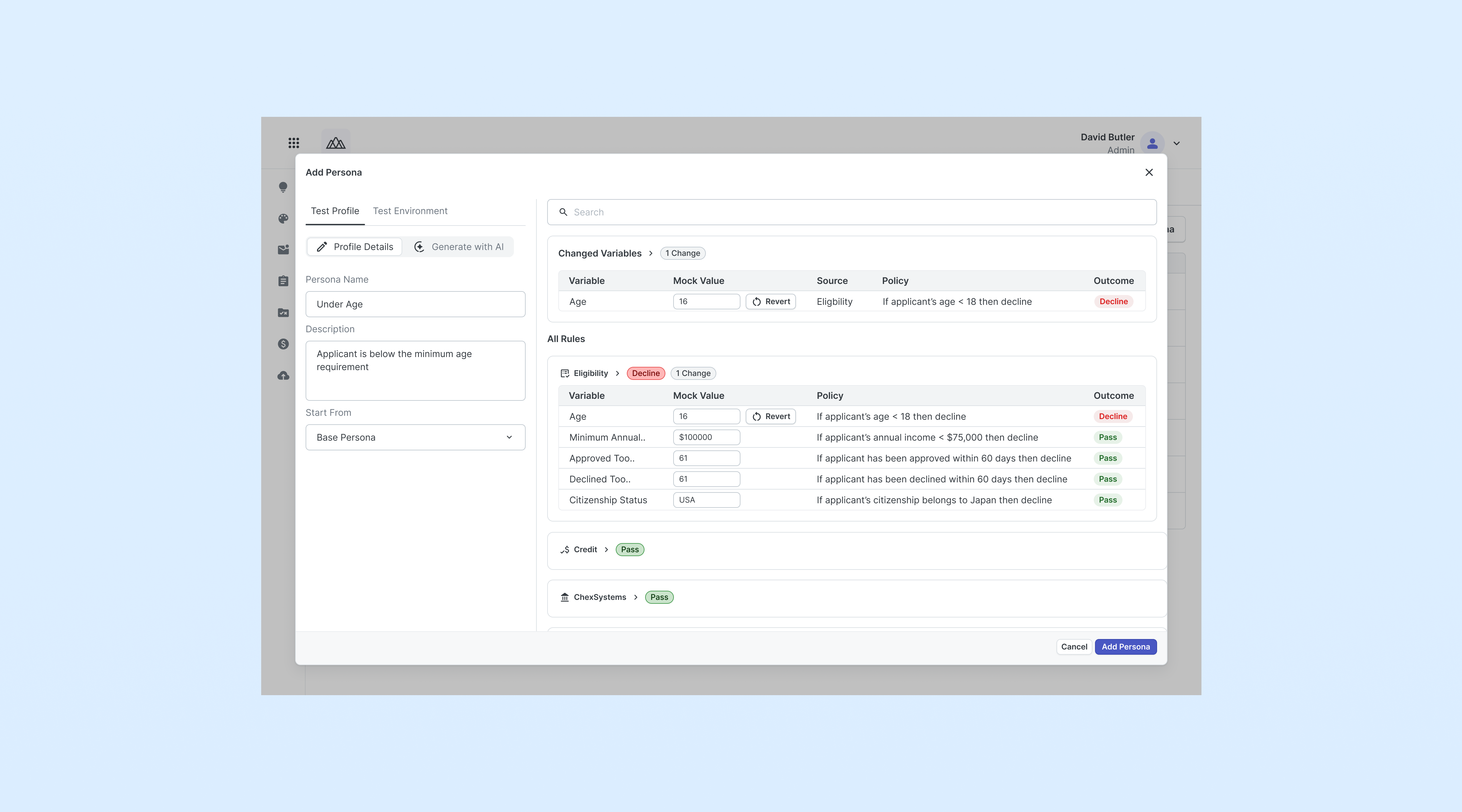
To ensure Intent-Output Alignment, I designed a workspace that mirrors the live production policy. Users don't just look at the code; they interact with a live simulation.
The Workflow: A manager can input a specific value—for example, setting a FICO score to 500—to verify that the policy correctly triggers a "Denied" status.
The Value: This provides immediate, visual proof that the policy logic is behaving exactly as intended before it is deployed to real customers.
MIRROR ENVIRONMENT INTERFACE
2. Multi-Persona Stress Testing (Solving for "The Ripple Effect")
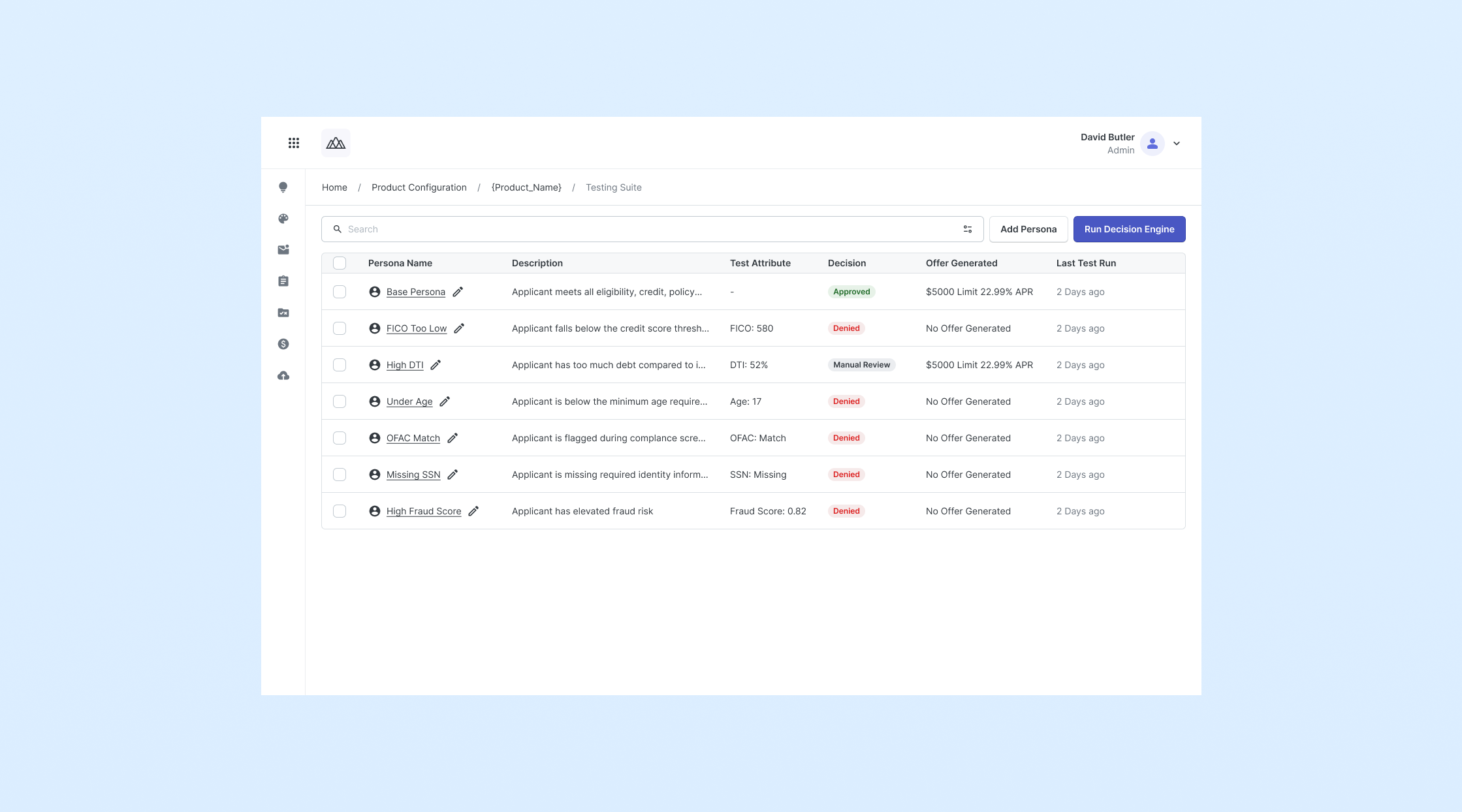
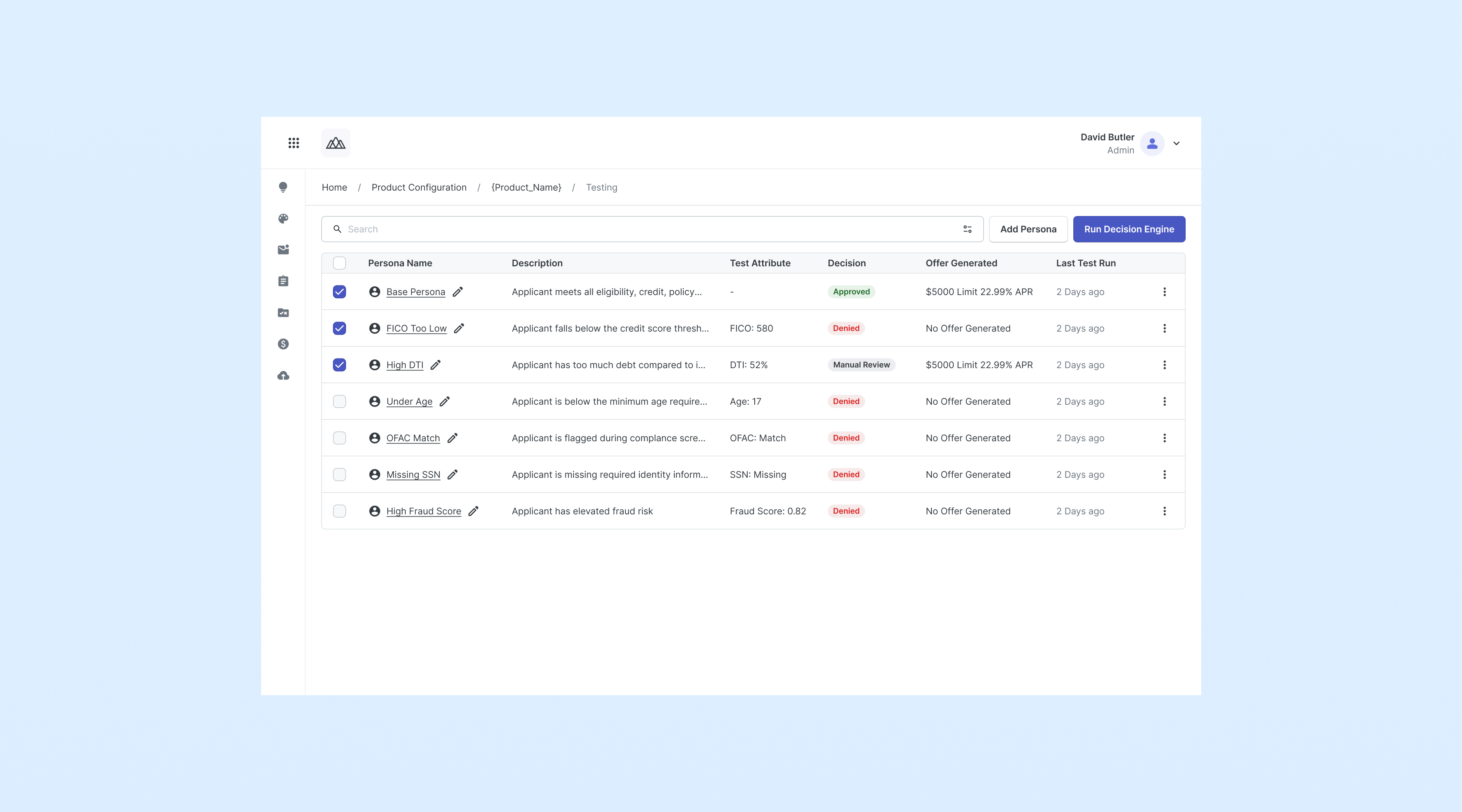
Testing one person at a time isn't enough to prove a policy is safe. I designed a Batch Persona Engine that allows managers to run multiple "what-if" scenarios simultaneously.
The Design: Managers can create a library of diverse personas (e.g., a high-debt student, a retired veteran, a first-time flyer) and run them all against the mirrored policy with one click.
The Value: This allows the manager to see if a rule change intended for one group accidentally "breaks" the approval for another, catching logic conflicts at scale.
BATCH PERSONA ENGINE
3. Smart Sorting & AI "Shortcuts" (Solving for "Information Scale")
Navigating 1,000+ variables to find the one you want to "poke" is a major bottleneck. I implemented two design interventions to keep the workflow fast:
The "Recently Modified" Pinning: Any variable the manager edits is automatically moved to the top of the list. They no longer have to hunt for their "mock inputs"—their active workspace stays front and center.
The AI Logic Agent: I integrated a natural language command bar. Instead of manually scrolling through 1,000 variables to find "Minimum Income Requirements," a manager can simply ask the AI to find it and change the value for them.
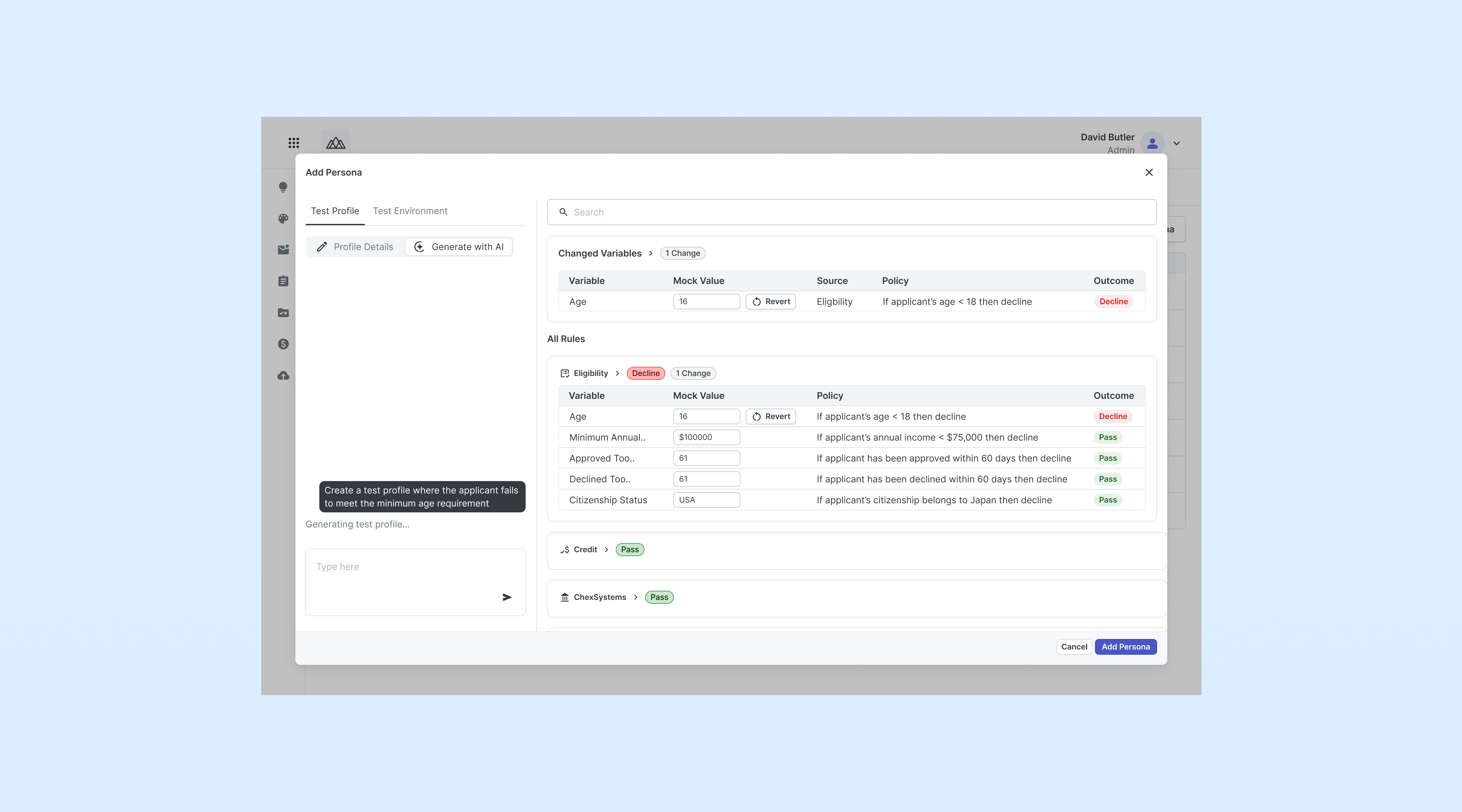
AI COMMAND BAR & SMART SORTING
RESULTS & IMPACT
From zero to hero
95% Reduction in Testing Cycles
Previously, a manager had to wait 14 days for QA and Engineering to write, run, and report back on a testing script. With the new Self-Service Suite, managers now perform the same verification in under 15 minutes.
Exponential Stress-Test Coverage
Before this tool, managers only had the bandwidth to test 3–5 "Happy Path" personas per policy. Now, they routinely run 100+ edge-case personas per simulation, identifying logic conflicts before they ever reach a customer.